Technical partner · part-time
I decide the architecture. I also write the code.
Senior technical time for companies that don't need a full-time CTO yet, or can't hire one yet. Five to ten hours a week, on a monthly retainer. Most people selling this attend meetings. I ship.
What you get
One person, both halves of the job.
The split most companies end up paying for is an advisor who decides and a contractor who builds, with a handoff between them where the reasoning gets lost. This is both, from the same head.
- Architecture and technical decisions. Stack, data model, what to build and what to buy, what will break at ten times the load and what won't.
- Code, written by me. Not oversight of someone else's code. The hard parts, the parts your team is stuck on, the parts nobody wants to own.
- Code review and standards for your team. If you have developers, they get a senior reader. If you don't, you get the thing built.
- Security judgement. The vulnerabilities that matter are usually business logic, and scanners don't find those.
- Written decisions. Architecture notes, data models, API specs, permission matrices. Your team can keep going without me.
- Investor-facing documents, when you need them. Unusual in this role and occasionally decisive — the technical section of a raise stops being a separate procurement.
The retainer is my time. When a build needs more hands than that, I bring in people I have shipped with before — but the architecture decisions stay with me, and you keep dealing with me. You are not handed to an account manager.
Pricing
Published, so you can rule it out in ten seconds.
Monthly retainer, billed monthly, cancel with thirty days' notice. No minimum term, because a minimum term is what people ask for when the work doesn't hold on its own.
Light
From $4,000/month
5 hours a week
You have developers and need someone to decide. Architecture, review, and the calls where a wrong answer costs three months.
Standard
From $7,000/month
8 hours a week
The usual one. I decide and I build — the hard parts land with me, the rest with your team or with nobody, depending on what you have.
Deep
From $8,500/month
10 hours a week
You're building the product now and the schedule is real. The largest block I take, because past this I'd be doing it badly.
I take a small number of clients on purpose. Ten hours a week of senior attention is worth more than thirty hours spread across six companies, and I'd rather say no than quietly become the bottleneck you hired me to remove.
Shipped, not advised
ScoPik — a platform in production.
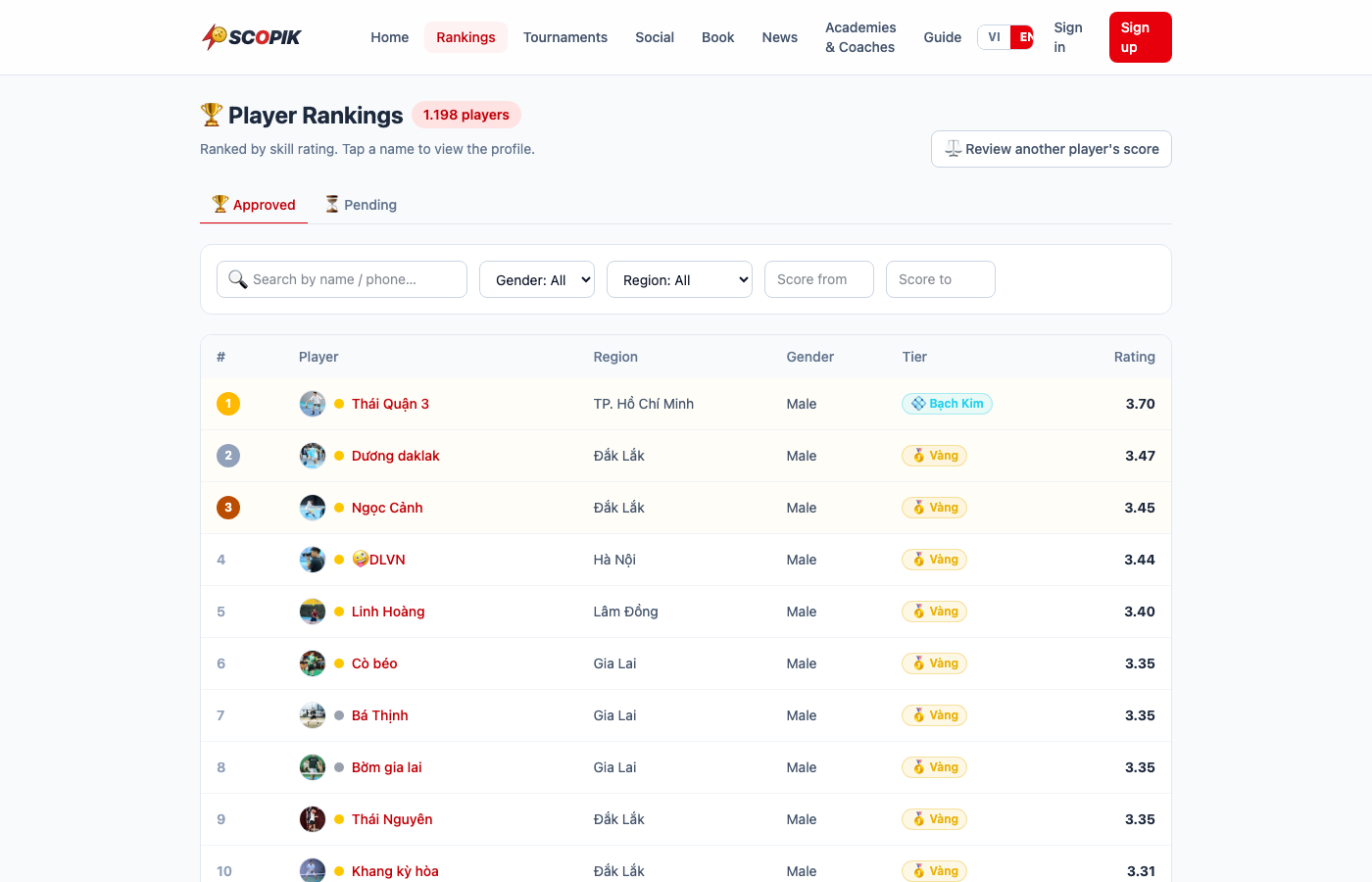
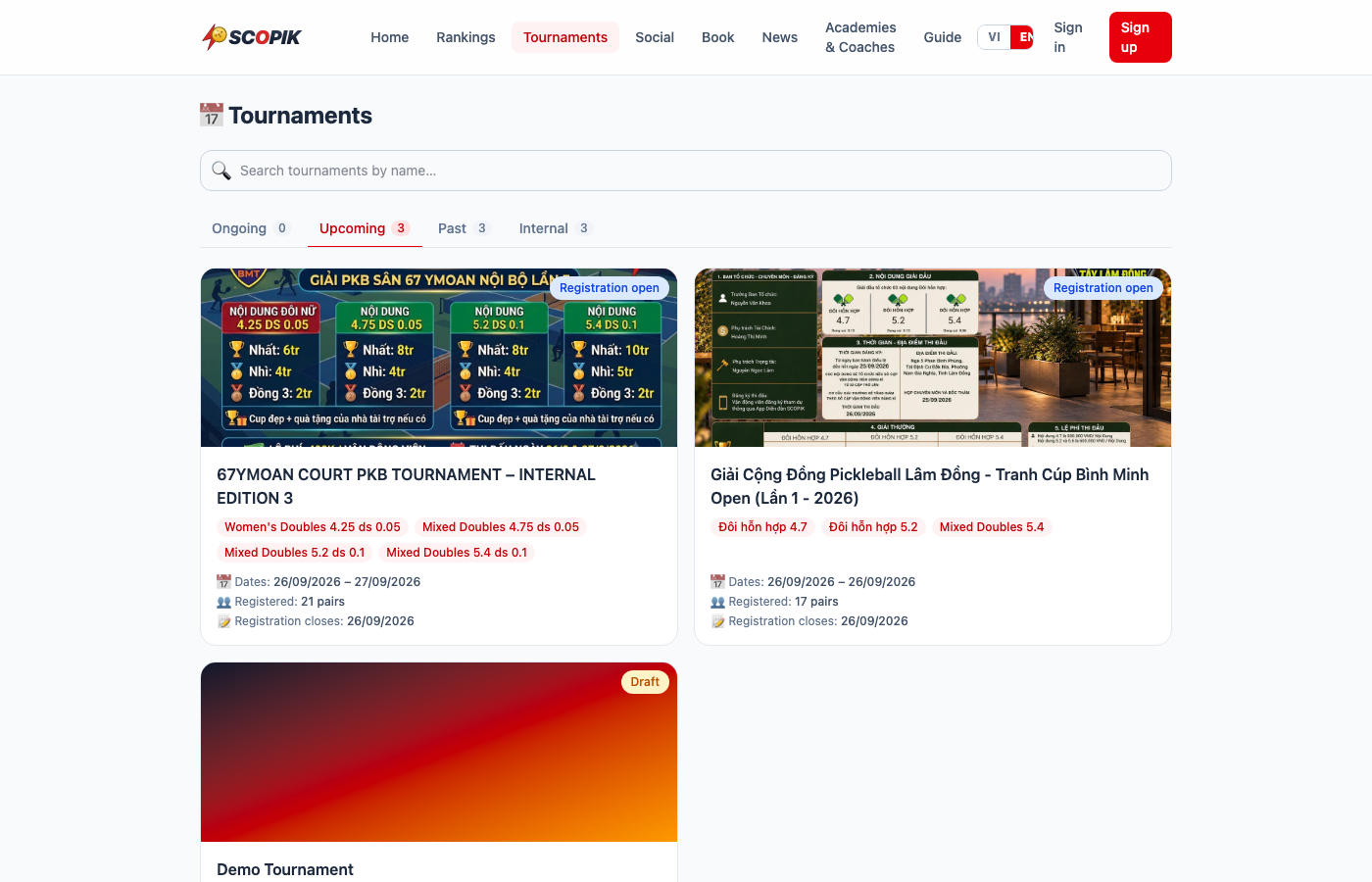
A pickleball platform built around tournaments: registration, brackets, referee score entry, live scoring down to the individual rally, national ranking, photo tagging by face, news and an academy section. I'm a partner in it and I run the technical side. I also write the code.
What it carries
Counted against production on 14 September 2026, two months after the first tournament went live: 1,198 ranked players — the figure on the public leaderboard, go and check it — 1,250 registered accounts, 10 tournaments, 995 registrations, 1,065 matches, 838 sets and 12,219 individual rallies. 15,343 notifications delivered. 929 squad players and 483 coach evaluations. 461 faces indexed across 159 tournament photos, so a player finds their own photos without anyone tagging them.
Next.js on Vercel, Laravel with Sanctum behind it, React Native via Expo on iOS, S3 for media. Live scores over Laravel Reverb websockets, so a match in progress updates on every open screen without polling. Nine backend modules from one relational schema. 410 commits across 45 working days, 48 of them in the last thirty. It still ships weekly.
The decision worth explaining
I commissioned a penetration test against the live system. It came back one High, one Medium, three Low, no Critical.
The High was not a generic web flaw. Any ordinary user could set their own ranking score through the profile endpoint and take the top of the public leaderboard. The scanner-shaped problems were clean — no privilege escalation, no cross-user writes, role and trust fields not mass-assignable, login rate-limited and enumeration-resistant. The one that mattered was business logic, and it went straight at the thing the product actually sells: a ranking people trust.
It's fixed. Writing to the score fields is server-controlled now, the way the trust model always implied it should be. That's the failure mode worth paying someone to find — a scanner doesn't catch it, because nothing was technically broken. The endpoint did exactly what it was written to do.
Also
Two more, at different ends.
RWA tokenization platform
A full venture build: bilingual whitepaper, pitch deck, five-year financial model with a live assumptions block, licensing strategy across seven jurisdictions, smart contract and off-chain technical plans, three costed build scenarios from $177k to $1.33M, and a working investor dashboard.
Client confidential. This is the engagement where the technical work and the investor documents came from the same person, which is the reason the numbers in the deck matched the model.
PSG HPP Pickleball Academy
A management system for a multi-branch academy, live with 6 classes, 20 students and 5 coaches. Thirty-three data models and forty-three screens: admissions as a real lead pipeline, enrolment, classes, scheduling, attendance, curriculum roadmap, coach assessments, fee packages, invoices, payments, notifications, and profit-and-loss reporting per branch.
Built from a written requirements specification — six MVP epics and twenty-seven user stories, each mapped to a numbered requirement, delivered in one pass with five technical documents so the academy's own developers can extend it. Most academy software stops at attendance, which tells a coach who showed up and tells an owner nothing. P&L by branch shipped in the first release.
Fit
Who this works for.
- A founder who can't yet justify a full-time senior hire. A CTO in Vietnam costs around 101 million a month before equity. Ten hours a week of the same judgement costs a fraction and carries no severance.
- A team with developers and no one to decide. Good juniors stall on architecture questions nobody is senior enough to close.
- A company raising money in the next year. The technical story and the investor documents come from one person who has done both.
And who it doesn't.
- Anyone who needs full-time availability. Five to ten hours a week is five to ten hours a week, and I'd rather lose the deal than miss the expectation.
- Staff augmentation — a pair of hands taking tickets. Cheaper people do that better.
- Work I can't argue with. If the architecture is already decided and not open to challenge, you want a contractor.
How it runs
Written-first, and you keep everything.
- Decisions in writing. Architecture notes and specs, not a verbal answer on a call you'll misremember in six weeks.
- Calls capped at two hours a month. Working hours 2pm–7pm Vietnam time, which is 8am–1pm in the UK and the working day across Southeast Asia.
- Billed monthly, thirty days' notice. No minimum term.
- You own all of it. Source, infrastructure, credentials, documents. Nothing runs anywhere you can't reach.
Start here
Tell me what you're building and what's stuck.
A short note is enough. If it's a fit I'll come back within two working days with the hours, the price and what I'd do in the first month. If it isn't, I'll say so and point you somewhere better.